Last reviewed: 28 August 2026
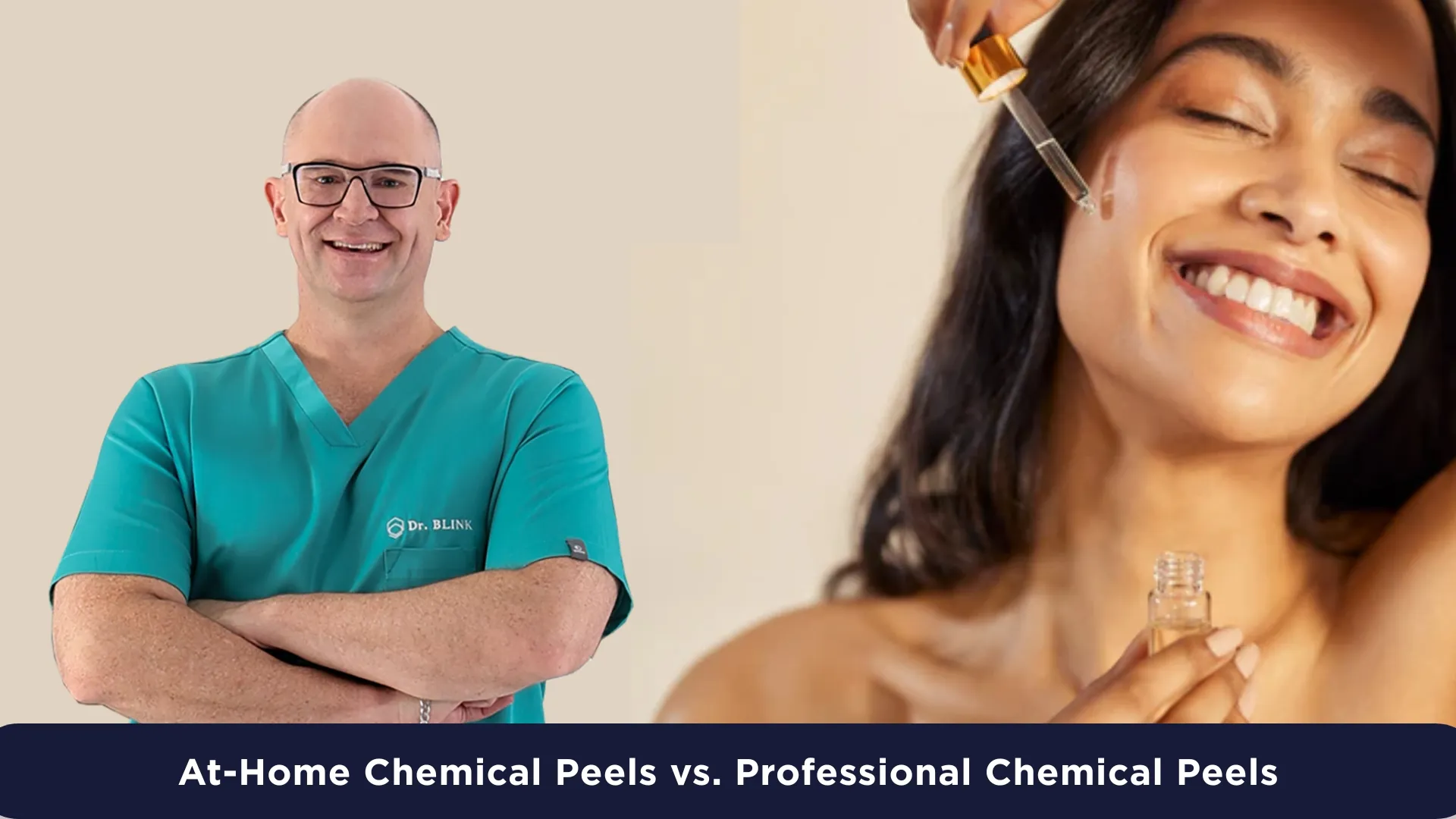
Chemical peels have become one of the most talked-about treatments in modern skincare. From “glass skin” trends on social media to shelves filled with high-strength acid products, many people are turning to at-home peels in the hope of achieving smoother, brighter, more youthful skin.
But not all peels are created equally.
At Dr Blink Medical Aesthetics & Laser Institute, we believe effective skin rejuvenation should always prioritise skin health, barrier integrity, and long-term results over aggressive short-term trends. While at-home exfoliating acids can play a valuable role in a skincare routine, professional chemical peels are medical-grade treatments designed with a far deeper understanding of skin physiology, penetration depth, pigmentation risk, and controlled skin remodelling.
This distinction is particularly important in South Africa, where intense UV exposure significantly increases the risk of post-inflammatory pigmentation and barrier damage following improper acid use. Over-exfoliation and unsupervised high-strength peeling can lead to inflammation, sensitivity, prolonged redness, and uneven pigmentation — especially in darker skin types.
True skin transformation is rarely achieved through aggressive, impulsive treatments. Instead, it comes from a personalised, phased approach that strengthens and restores the skin while targeting concerns safely and effectively.
Before reaching for the next trending acid product, it is important to understand the difference between superficial home exfoliation and clinically supervised chemical peeling — and why professional guidance matters.
Why Your DIY “Chemical Peel” is Often Just an Exfoliant
The most significant “brutal truth” is that many products marketed as at-home “peels” are, by clinical standards, merely cosmetic exfoliants.
According to the Expert Consensus on Chemical Peels, concentrations of Alpha Hydroxy Acids (AHAs) ≤6% and Salicylic Acid (SA) ≤2% do not technically qualify as peels. They are designed for surface-level maintenance, not deep structural change.
- AHAs (Glycolic/Lactic Acid): Consumer safety regulations generally cap at-home AHA concentrations at 10%. In a clinical setting, we routinely use concentrations reaching 70% to target the deeper dermis.
- BHAs (Salicylic Acid): Over-The-Counter products are capped at a 2% limit. While excellent for daily maintenance, they lack the caustic power of professional formulas.
- The pH and Collagen Factor: Potential is dictated by pH. Most at-home products are “buffered” to a pH of approximately 4.0. While some studies indicate that a pH of 4.0 can stimulate collagen production without the inflammation of a true peel, it cannot achieve the deep epidermal renewal of a clinical formula with a much lower, unbuffered pH.
- The Bactericidal Edge: For South Africans dealing with congestion from humid coastal air or city pollution, Glycolic Acid (GA) is the maintenance king. Clinically, GA possesses bacteriostatic and bactericidal effects on P. acnes, making it a powerful tool for preventing breakouts before they begin.
The “Frosting” Factor and the Chemistry of Neutralisation
In a medical suite, we use “frosting” as a vital clinical endpoint. Frosting is the white, frost-like appearance caused by the coagulation of skin proteins when exposed to strong acids like Trichloroacetic Acid (TCA). There are three grades:
- Grade 1: Scattered pinpoint frosting on a background of redness (erythema).
- Grade 2: A cloudy-white appearance, indicating the acid has affected the entire epidermis.
- Grade 3: Pure white frosting, signifying that the peel has reached the dermal layer.
The Danger of DIY Neutralisation
A critical distinction lies in the chemistry of how these acids stop working.
AHAs (like Glycolic acid) do not self-neutralise; they will continue to “digest” your skin tissue until an alkaline solution (usually 10.0%–15.0% sodium bicarbonate) is applied. In the clinic, we monitor this until the “foaming” stops.
At home, users often rinse inadequately, leaving active acid to cause delayed-onset burns. Conversely, TCA is a self-neutralising agent that stops acting once it has coagulated with enough protein,but managing that depth requires the discerning eye of a specialist.
A Tale of Three Depths: Managing the Big Reveal
The following table, based on Cleveland Clinic data, outlines the recovery you should expect when moving beyond the bathroom counter:
| Peel Depth | Layers Targeted | Recovery Time | Best For |
| Light (“Lunchtime”) | Outermost epidermis | Hours to a few days | Fine lines, mild acne, and refreshing a dull texture. |
| Medium | Epidermis + upper dermis | 7 to 14 days | Age spots, moderate wrinkles, and superficial acne scars. |
| Deep | Lower reticular dermis | 14 to 21 days (bandaged) | Extensive sun damage, deep scars, and precancerous growths. |
Note: A deep peel is a “one-time only” event for the face and requires significant clinical preparation.
First Aid for the DIY Disaster
While professionals handle the high-strength “secret weapons,” the reality is that many consumers find themselves managing DIY disasters. If an at-home treatment causes intense pain (a 7/10 or higher on the pain scale), greyish skin, or immediate blistering, follow these first aid steps:
- Immediate Removal: Stop application and remove any product-contaminated clothing.
- The 20-Minute Rinse: Flush the area with cool running water for a full 20 minutes. Tip your head over the sink to ensure runoff doesn’t enter your eyes.
- The “Don’ts”: Avoid oils, butter, or unknown balms. Use only plain petroleum jelly to keep the wound moist and prevent a crust from forming too early.
- Red Flags: Seek an emergency room immediately if you experience a rapidly spreading rash, swelling of the lips or throat, or difficulty breathing.
Post-Peel Protocol: The Golden Rules
Regardless of the depth, your aftercare determines the final result. Treat your skin like a newborn for at least seven days:
- Sunscreen is non-negotiable: Use a Broad-spectrum SPF 50+ daily. In the SA climate, new skin will pigment instantly if exposed to the sun.
- Hands off: Do not pick, rub, or scratch at crusts. Forcing skin to shed leads to permanent scarring and possible pigmentation.
- Simplicity: Pause retinoids, Vitamin C, and all other acids for at least one week.
- Moisturise: Use only bland, fragrance-free creams to support the barrier during its phased reconstruction.
Dr Blink: Professional Chemical Peels That Make A Difference
At Dr Blink, our mission is to empower individuals to age gracefully. Our philosophy is simple: enhance what’s already there. Rather than dramatic transformations, Dr Blink is known for subtle, combination-based treatments that work with your skin’s natural biology, helping you become the best version of a natural you.
In addition to chemical peels, we also offer:
- Biostimulators
- Botulinum toxin injections
- Skin boosters
- InMode Laser: Morpheus 8, Forma and Lumecca
- SkinPen
Leave chemical peels in the hands of a professional. Book your consultation and enjoy a tailor-made skin plan.
